Coal and chemistry
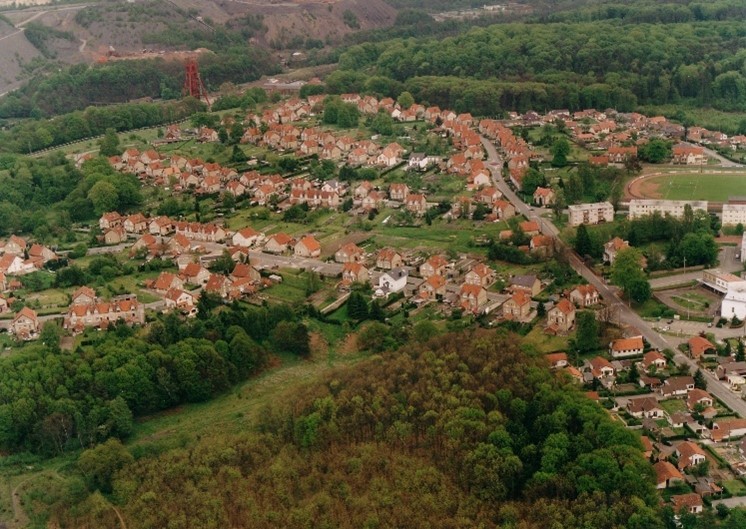
The development of coal mining turned Saint-Avold into a town of residence. In 1928-1930, Société Houillère Sarre-et-Moselle built a housing estate of six hundred and fifty dwellings, named Cité Jeanne d'Arc in 1932 and located near the Sainte-Fontaine well.
Most of the new arrivals were of Polish origin, transiting through Westphalia to work in the Lorraine coal mines. 1,205 Poles lived in Saint-Avold in 1931, including 1,032 in the new cité Jeanne d'Arc.
Thanks to its location at a pleasant crossroads, the town became a residential center for the basin. Between 1945 and 1966, Houillères du Bassin de Lorraine built more than 1,300 homes here, and the population grew from 7,054 to 18,000 in the Wenheck, La Carrière, Émile Huchet and Arcadia housing estates.
The development of the Émile Huchet thermal power plant and the Carling industrial site between 1949 and 1960 took on exceptional proportions. The Carling coking plant came into being with the development of the carbonization process. After 1954, it gave rise to a number of plants and facilities that together make up one of France's largest chemical platforms.
From the 1960s onwards, the town continued to expand to the north and east, accelerated by the construction of the Metz-Sarrebruck freeway in 1969-1970. As the coal era drew to a close, the city pursued a policy of industrial diversification, with the creation of the ZIL du Gros-Hêtre industrial and craft zone in 1968-69, and a 46-hectare industrial zone at Hollerloch in 1975. In the 1960s-1970s, the town acquired modern infrastructures: two high schools, three middle schools and a swimming pool with a sports complex.
The town marked Franco-German reconciliation by twinning with Dudweiler in Saarland, one of the first of its kind, on June 28, 1964. Since June 30, 1994, it has also been twinned with Fayetteville, North Carolina.