The Naborian City
THE EVOLUTION OF A CITY
" Saint-Avold played a leading role in the history of Lorraine. It sheltered within its walls Dukes of Lorraine, Kings of France and Emperors of Germany" wrote the great Benedictine historian Dom CALMET in the 18thcentury .
From the founding of the town to Saint-Avold as a merchant
Numerous Paleolithic and Neolithic human remains have been discovered on the town's territory. Gallo-Roman villas were later built.
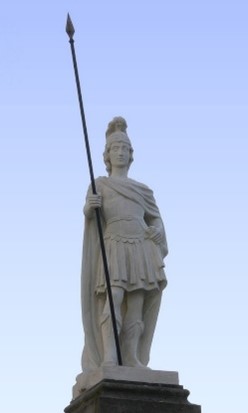
The town was founded by Sigisbaud, Bishop of Metz in 722, when he established a monastery between Rosselle and Mertzelle, on the site of a villa originally belonging to Hilar. His successor, Chrodegang (712-766), minister to Charles Martel and Pepin le Bref, returned from a diplomatic trip to Rome at the end of August 765 to deposit the relics of Saint Nabor, an officer martyred around 309. This Saint was to give his name to the abbey and town that grew up in the shadow of the monastery, protected by the bishops of Metz and renowned for its scriptorium.
In the 11thcentury, the inhabitants of the episcopal town of Saint-Nabor or "Santerfor" placed themselves under the protection of a lay lord known as the avoué. The first were the Episcopal Counts of Metz, then around 1160, Bishop Étienne de Bar (1120-1162) entrusted the avouerie of Hombourg-Saint-Avold, i.e. the town and some twenty villages, to the Counts of Saarbrucken and the Lords of Créhange, his vassals.
The town was enfranchised by the bishops before 1302. It was then the seat of a special justice system, the mother-court. With its Germanic language and traditions, the town adopted a customary law or "Stadtrecht", codified in 1580, which specified, among other things, the functioning of the municipal institution and local law.
"Santerfor" was an active commercial center in the 14thcentury, serving as a staging post for French, Lorraine and even Rhineland merchants on their way to Nancy and Vaudrevange (Wallerfangen), capital of the German bailiwick. Large guilds of tanners, weavers and butchers were created in the mid-15thcentury. They exported their products throughout the Rhineland and even to the North Sea. Three regionally renowned fairs boost the local economy every year. Leather, hemp, wool and cattle are traded.
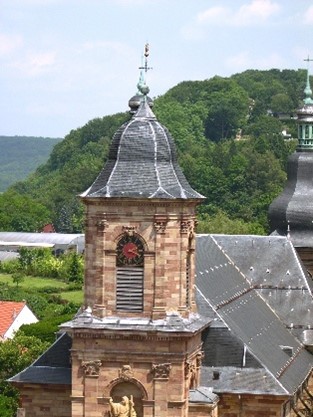
The town is also a unique German-speaking parish. It boasts a church with Carolingian foundations, dedicated to Saints Peter and Paul, enlarged in 1492 - 1500 by Adam de Roupeldange, who had been abbot of the Benedictine monastery since 1140. The church was used for parish worship until 1792, when it was disused and replaced by the brand-new abbey church, following the abolition of the Benedictine monastery.
From the Duchy of Lorraine to the Kingdom of France: 1581 - 1766
On May 16, 1572, Cardinal Charles I ofLorraine, Bishop of Metz, ceded the avouerie of Hombourg-Saint-Nabor to his nephew Henri I, Duke of Guise. He in turn sold it on November 24, 1581 to Charles III, Duke of Lorraine. The town became part of the Duchy of Lorraine, an independent state that enjoyed its golden age. It was the economic capital of a seigneury of some thirty localities, administered by a ducal bailiff based at Hombourg castle.
The town underwent a remarkable demographic expansion, reaching 2,000 inhabitants in 1628. In 1621, Henri II, Duke of Lorraine, gave his lands as a wedding gift to Henriette de Lorraine and Louis de Guise, who stimulated trade and the economy of the seigneury. The town created a suburb, and master glassmakers developed the glass industry at Ambach, whose products were exported as far away as Rotterdam. Princess Henriette founded a Benedictine convent in 1631 and established the region's first bilingual girls' school.
During the Thirty Years' War (1618-1648), the town was repeatedly occupied and pillaged by the French and Swedes. Epidemics, famine and war wiped out a large part of the population. Some inhabitants fled to the Rhineland and Luxembourg. By 1656, the town had only eighteen inhabitants.
The Treaties of Ryswick and Paris in 1697 and 1718 brought peace. The Naborian demography was restored in 1750-60, fortified by the Tyrolean influx of 1700-1720. The economic and administrative measures taken by Duke Leopold after 1698 favored the reconstruction of Saint-Avold, which was then designated as the chief town of a provostry of twenty-three villages in a new bailiwick of Germany. To thank the town for its loyalty, the Duke granted it his coat of arms, the full arms of Lorraine. The economic upturn of 1715-1730 saw the construction of over two hundred new houses. A new Hôtel de Ville (28, rue des Américains) was built in 1735.
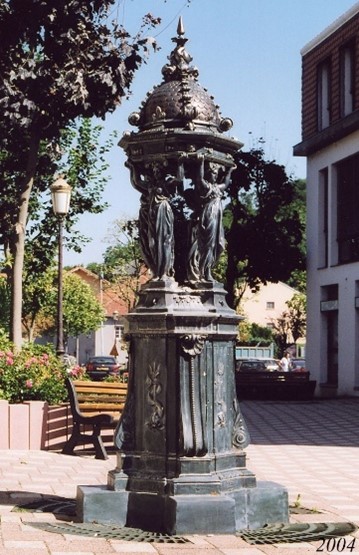
A series of beautiful Germanic-style fountains, built in 1714 by master mason Melchior Spinga from Milan, with the help of Tyroleans, adorn the town center.
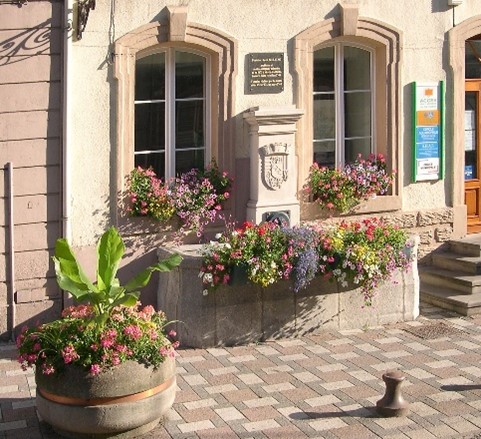
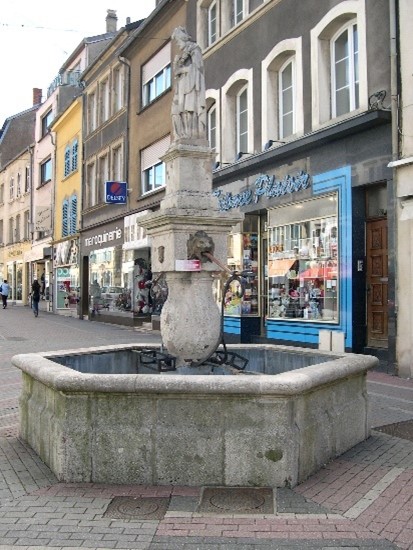
The "belle XVIIIesiècle" left its mark on the town center. Beautiful bourgeois homes, with carved doors and mansard windows, bear witness to the wealth of the commercial bourgeoisie. Several artists' dynasties, such as the Metzinger and Melling families, settled in Saint-Avold when the abbey was rebuilt in 1720-1790.
The town regained its role as a staging post between the Germanic world and France. A number of the town's families, including d'Avrange, Kaiser and Hennin, chose to serve the Habsburgs and accompanied the Duke of Lorraine François III (1708-1765) to Austria. There, they enjoyed successful careers in the army and administration. The reign of the Polish king Stanislas (1677-1766), who became Duke of Lorraine, was only nominal. His French intendant, François Chaumont de la Galaizière, introduced the highly unpopular French system of corvée and militia, and increased taxes. Like the rest of ducal Lorraine, the town became French in 1766.
From the Revolution to annexation: 1789-1870
The Revolution was initially welcomed without problems, but the Civil Constitution of the Clergy of 1791 and the de-Christianization measures taken in 1793 were to offend public opinion, which was already irritated by the dissolution of monastic orders. The terror led to the emigration of sixty-three people in 1793-1794. Saint-Nabor became Rosselgène. The cult of the "Supreme Being" was instituted. The large number of refractory priests benefited from the widespread complicity of a large part of the population.
The town faced a deteriorating financial situation and constant troop movements. It was the administrative center of a canton and had difficulty integrating into the new department created in 1790, despite the help of its first deputy, Joseph Becker (1743-1812), who was one of the only Moselle deputies to vote against the execution of Louis XVI.
The Consulate and then the Empire restored calm and religious peace with the signing of the Concordat and the moderation of Jean Nicolas Houllé (1750-1841), archpriest of Saint-Avold.
Economic prosperity prevailed until 1813. The Empire enjoyed widespread popularity. General Baron Georges Kister (1755-1832), mayor of the city from 1812 to 1814 and again from 1817 to 1824, had a distinguished career in the service of Napoleon I as governor of Salzburg and Danzig.
In January 1814, General Gebhard Leberecht von Blücher established his headquarters in Saint-Avold. The Bavarian occupation continued until 1818.
Subsequently, the Legitimist town went through all the regime changes (Restoration, July Monarchy and2nd Republic) without any resistance. Napoleon III and the Second Empire were very popular.
Industrialization developed very slowly in the first half of the 19th century. Crucible factories, foundries, flannel factories, tile factories, breweries, Prussian blue factories, earthenware factories and fifteen tanneries provided work for a growing number of Naborians. Nevertheless, many inhabitants fled the harsh living conditions, the food shortages of 1817-1818, the cholera epidemics of 1833 and 1866, and the economic crises of 1845 and 1846, emigrating to the United States. Some families, like the Collin and Risse families, made their fortune in the New World, while others chose the Paris basin or the new French colonies that were being created.
The opening of the Metz-Saint-Avold railroad line in 1851, followed by Saint-Avold-Forbach-Sarrebruck (1852), and the discovery of coal in Carling with the opening of the Max shaft in 1862, established Saint-Avold's development.
The town was the birthplace of twenty-three generals, including Auguste Édouard Hirschauer (1857-1943), future senator for Moselle, who was deeply involved in the development of French aeronautics from 1910 onwards. It is the birthplace of Father Pierre Victor Braun (1825-1882), founder of the Servants of the Sacred Heart of Jesus congregation established in France, England and Austria, with its motherhouse in Versailles.
The Second Reich from 1870 to 1918
The town became part of the Second Reich, along with the Moselle and Alsace departments, following the signing of the Treaty of Frankfurt on May 10, 1871, which was accepted by the National Assembly in Bordeaux by an overwhelming majority of deputies.
From 1885-1890, at the urging of shopkeepers and craftsmen, the town became a garrison town, with a massive influx of military personnel and their families, in a dynamic environment typical of the German Empire. The town developed along an axis linking the town center to the new De Brack barracks, formerly the Jäger Kaserne, built in 1911-1913, the Lahitolle barracks, formerly the Artillerie Kaserne, built between 1880 and 1890, the Mahon barracks (Ketzerrat-Kaserne) and the Hamon barracks (Berg-Kaserne), occupied by the 14th Regimentof the Hanover Uhlans since 1886. Protestantism developed rapidly, with the construction of the Protestant Lutheran church in 1887-1889, which became the garrison church and was inaugurated on April 22, 1889.
By 1900, the town had 5,000 inhabitants, rising to 6,400 by 1910, including 2,500 military personnel. The town participated in the general prosperity and developed new infrastructures (tramway inaugurated in 1911, water, gas and electricity) thanks to the very dynamic career mayors, including Joseph Koestel (1872-1960).
Garrisons introduced service activities to supply the trade. Tavern-keepers benefited from military activities and the bustle of the town. New buildings bear the imprint of neo-Gothic and neo-Renaissance styles. The courthouse and hospital were designed by architect Weissdorf in neoclassical style. The end of the 19thcentury saw the definitive establishment of the town's spatial organization. Poincaré, Hirschauer and Place de la Victoire were the main shopping streets, while the Rue des Américains and Rue de Gaulle were the main service and financial streets. The military nobility occupied the new rue Houllé, avenue Clemenceau and rue de la Carrière, while craftsmen and workers occupied rue des Tanneurs, rue de la Montagne, rue de l'Hôpital and rue de la Mertzelle, while barracks were built on the outskirts.
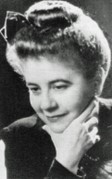
This period saw the birth of Adrienne Thomas (1897-1980), a German-language writer who recounted the city's imperial past, as well as the 1933 bestseller :
"Catherine soldat", an anti-militarist book condemned by the Nazis.
The town returned to France after the Entente victory on November 11, 1918. In the inter-war period, after a difficult period of reintegration into France, it retained its character as a garrison town. Numerous regiments, such as the 18th Régiment de Chasseurs à Cheval, took up residence in the fine modern barracks left behind by the Germans.
The town marked Franco-German reconciliation by twinning with Dudweiler in Saarland, one of the first of its kind, on June 28, 1964. Since June 30, 1994, it has also been twinned with Fayetteville, North Carolina.
A city confident in the future and a great place to live
The 1990s saw the creation of a regional plastics testing and applications center, inaugurated on June 29, 1990, and enlarged to 1,740m2 in response to its growing success.
On November 5, 1994, an I.U.T. for fine chemicals was inaugurated. In partnership with Saarbrücken, the S.I.V.O.M. created the "Europort" industrial zone, specializing in transport logistics.
On September 1, 2004, Saint-Avold created the Communauté de Communes du Pays Naborien from the ten communes of the former SIVOM (Altviller-Carling-Diesen-Folschviller-Lachambre-L'Hôpital-Macheren-Porcelette-Saint-Avold and Valmont).
Today, it is the capital of the "Saint-Avold Synergie" agglomeration community, created onJuly 1,2017, with 41 communes including the Communauté de communes du Pays Naborien and the Communauté de communes du Centre Mosellan, representing an employment area of 55,370 inhabitants.
The town is pursuing its economic development with the creation in 2010 of a new commercial and retail site in the Agora zone, behind the intercommunal swimming pool, as well as the development of new industrial sites on Route du Puits.
This industrial diversification is not without a certain search for quality of life. Saint-Avold's vast woodlands have made it possible to set up a day-care center and an equestrian center with a fitness trail and numerous hiking paths.
On the Felsberg hill, an international meeting center with a series of rooms, a community restaurant and a campsite for Dutch and German tourists.